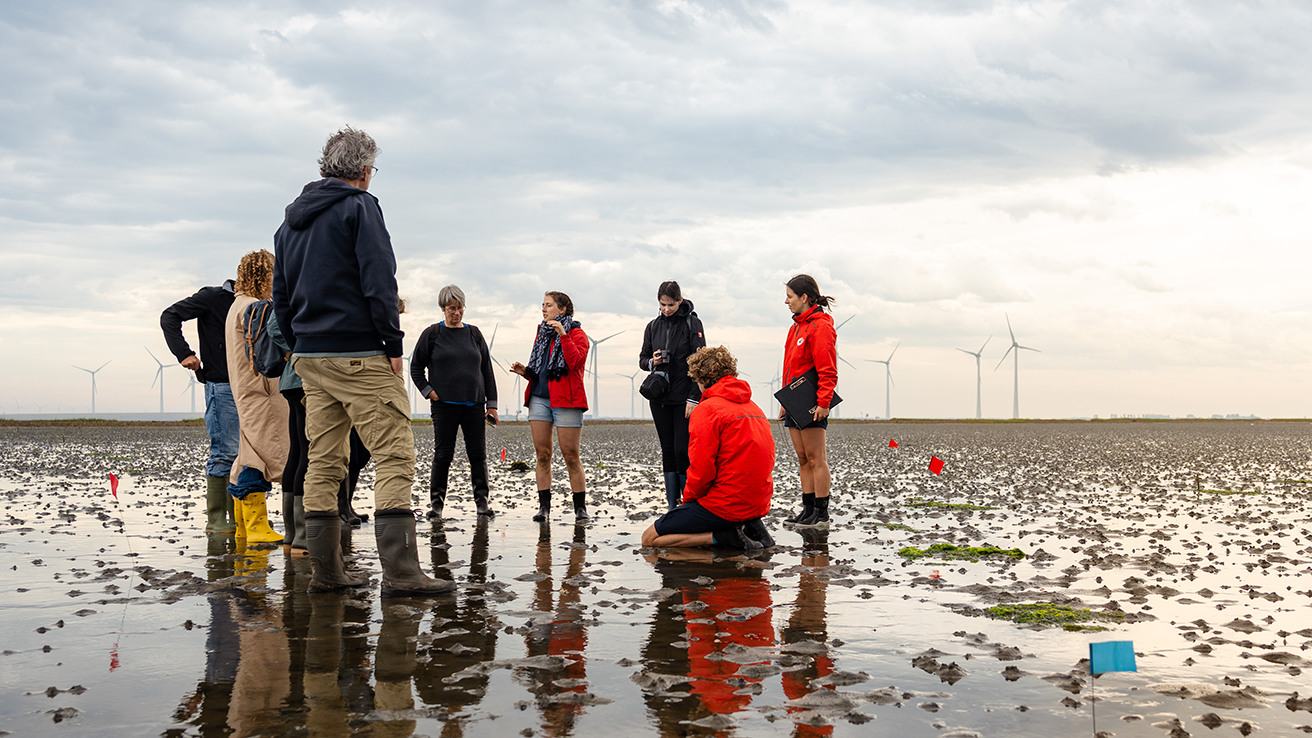
Journalists joined the Sea Ranger Service, the University of Groningen and Nestlé Purina in Zeeland for a rare behind-the-scenes look at active seagrass restoration in the Oosterschelde.
Participants saw how seagrass restoration is carried out and how its results are monitored over time. The press day came at an important moment: the new EU Interreg North-West Europe project REBORN has recently launched to help accelerate seagrass restoration across Europe.
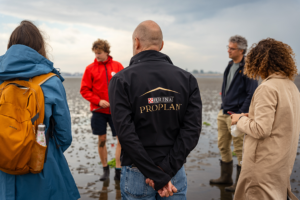
The field visit took place at Slikken van Oude Tonge, one of two locations identified as particularly promising for scaling up restoration in the Oosterschelde. Journalists observed how Sea Rangers collect data, use specialist monitoring equipment and assess whether transplanted seagrass is taking hold. They also learned how researchers track the development of restored meadows and investigate their effects on biodiversity and the wider coastal ecosystem.
“Seagrass restoration takes time, patience and a great deal of careful fieldwork. Monitoring allows us to understand what is working, how the plants are developing and where our methods need to be adapted,” said Elise Chalcraft, Seagrass Restoration Project Coordinator at the Sea Ranger Service. “Over the past 10 years, Sea Ranger Service has grown from a pioneering idea into an organisation delivering marine restoration projects across Europe. This press day offered an opportunity to show the progress we have made and how young people are playing a vital role in restoring coastal ecosystems.”

A largely overlooked but vital coastal habitat
Although seagrass receives far less public attention than habitats such as coral reefs, it is one of the world’s most valuable coastal ecosystems. Seagrass can form extensive underwater meadows that provide habitat and nursery grounds for fish and other marine species, improve water quality, store carbon and help protect coastlines.
Unlike algae, seagrass is a flowering plant with roots, leaves and underground rhizomes that connect individual shoots. Only around 70 species exist worldwide. Two occur in the Netherlands: eelgrass and dwarf eelgrass. Depending on the species and local conditions, they can grow in intertidal areas exposed at low tide or remain permanently submerged in shallow waters where sufficient light reaches the seabed.
Despite its importance, an estimated 30-40% of the world’s seagrass has already been lost. Pollution, declining water quality, coastal development, physical disturbance and other human pressures continue to threaten the habitat. The loss of seagrass also means the loss of the biodiversity and ecosystem functions supported by these meadows.
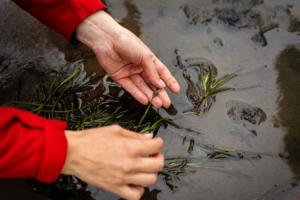
Restoring seagrass in the Oosterschelde
Since the 1980s, seagrass coverage in the Oosterschelde has declined by approximately 90%. Recovery has remained limited despite the area’s good water quality. Restoring seagrass is particularly important because the Oosterschelde is a national park of exceptional ecological value and also supports recreation and blue mussel cultivation.
Since 2023, Sea Ranger Service and seagrass experts from the University of Groningen, working through the Seagrass Consortium, have been collaborating to restore the Oosterschelde’s lost seagrass meadows.
In 2025, large-scale restoration trials began covering eight hectares. Over the past three years, Sea Rangers, together with the University of Groningen, have:
- Sown more than 150,000 seeds from two seagrass species;
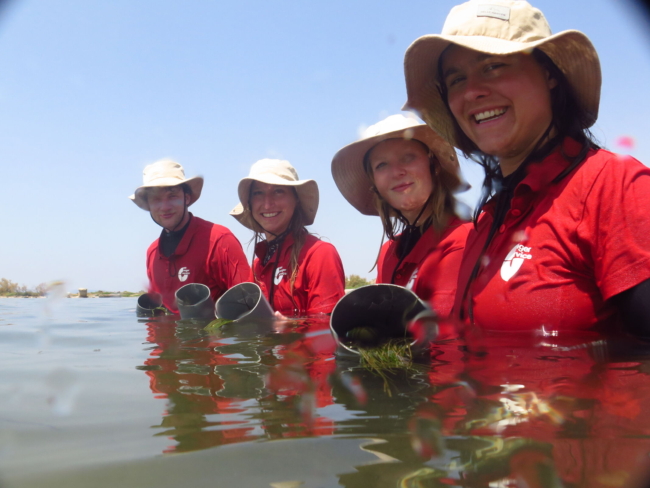
- Transplanted more than 13,500 seagrass cores;
- Tested restoration approaches across 14 locations;
- Begun larger-scale trials at the two most promising sites; and
- Continued monitoring earlier restoration work to understand how the meadows develop over time.
Alongside monitoring plant survival and growth, the project team is assessing the ecological impact of the restored habitat, including changes in biodiversity and the use of the area by fish and other mobile species.
“Restoration is not simply a matter of planting seagrass and walking away,” said Laura Govers, Associate Professor in the University of Groningen. “The plants need time to grow and develop into a meadow. We need long-term monitoring to understand how the plants respond to local conditions and whether restored areas begin to function as healthy ecosystems, for instance by raising biodiversity. The practical capacity of the Sea Rangers, combined with the University’s seagrass expertise, allows us to scale on a level that would otherwise be difficult to achieve.”
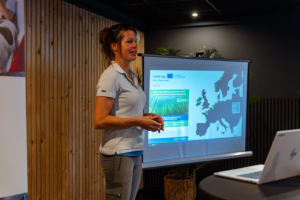
The Oosterschelde restoration work is supported by Rijkswaterstaat and Natuurmonumenten and forms part of both the Seagrass Consortium and the EU Interreg North-West Europe REBORN project. It is funded by Nestlé Purina and several other funders.
“Seagrass plays an important role in healthy ecosystems and provides food and shelter to many species, including fish,” says Bob de Vries, Business Manager Veterinary & Breeder at Nestlé Purina. “With our Ocean Restoration Programme, we want to contribute to nature restoration as well as to solutions that are applicable on a larger scale. The collaboration in Oosterschelde shows what is possible when science, nature organisations, young professionals, and the business community join forces.”
As Sea Rangers expand their restoration efforts and REBORN begins its work across North-West Europe, the partners will continue restoring and monitoring seagrass in the Oosterschelde while sharing lessons that can help accelerate recovery elsewhere.